God
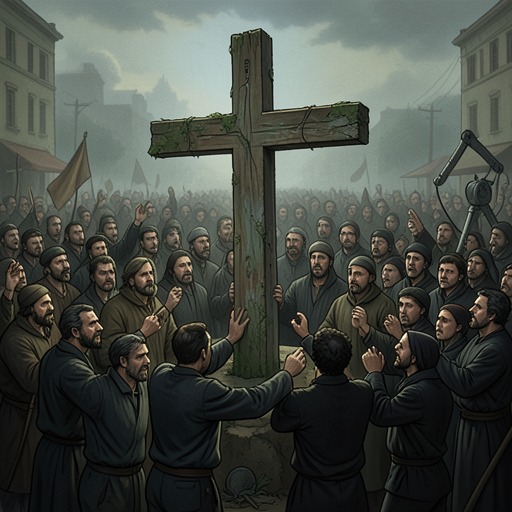
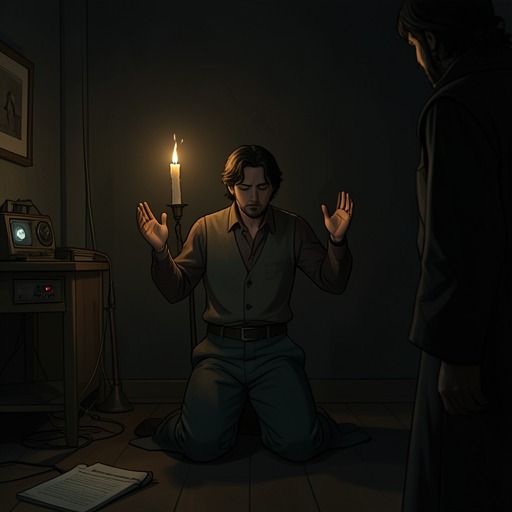
The Ownership Wars: Who Owns YouGod is presented less as a developed dramatic character than as a decisive figure in the book’s argument about causation, reality, and the limits of scientism. The text invokes God at the point where physical explanations confront the origin of physicality itself, making the figure central to its contrast between religious faith, mathematical rationalism, and scientific materialism.
God and the Origin of the Universe
The discussion begins with the problem of the Big Bang. If the physical universe is caused, its cause cannot itself belong to space, time, and matter, because those conditions came into existence with the physical universe. If it is uncaused, the text argues, its existence becomes a miracle or an act of magic. Either possibility challenges physical causal closure, the doctrine that every physical event must have a sufficient physical cause within the physical domain.
This dilemma is used to place God within a wider dispute over what counts as reality. The text argues that scientism cannot explain what caused physicality without appealing either to an impossible self-causing universe or to a non-physical cause that its own materialist assumptions exclude. God therefore functions as a test case: dismissing a transcendent cause does not remove the causal problem, but leaves scientism with what the book describes as an unexplained act of self-creation.
A Rival to Scientism
The book identifies theistic belief as one established response to the question of what preceded the Big Bang. It contrasts the theistic God associated with Abrahamic religion with the pantheistic God or undefined divine process associated with Eastern religion. These alternatives are introduced as competing answers to the same metaphysical question rather than as episodes in a personal religious narrative.
The text’s sharper claim is that scientism replaces God with abstract probability functions. It criticizes the idea that mathematical probabilities can somehow collapse into concrete physical reality, insisting that an unreal abstraction cannot by itself become a real agent. In this formulation, God represents the missing explanatory principle that scientism tries to conceal: something capable of grounding the transition from possibility to actuality.
Mathematics as Divine Principle
Although the book raises the theistic God as an answer, it ultimately redirects the argument toward eternal mathematics. Mathematics is described as preceding physicality, existing outside space and time in an immaterial Singularity, and supplying the rational order from which physical science becomes possible. Because science cannot operate without mathematics, the text treats mathematics as the cause, creator, or generative source of science.
This account gives God a conceptual rather than conventional theological identity. The mathematical universe is described as the immaterial and eternal mind of the cosmos, while the scientific universe of spacetime and matter is its material and temporal body. God is consequently aligned with the Principle of Sufficient Reason: reality is not fundamentally governed by arbitrary chance, but has an exact explanation.
Cosmic Reincarnation and Human Reflection
The mathematical mind is linked to successive physical universes. A Big Bang universe is said to be born, grow, decay, and die, after which another universe is born in a perpetual succession of Big Bang universes. Each universe is therefore treated as a physical reincarnation, while the mathematical mind persists as the principle connecting one physical body of the cosmos to the next.
The text extends this cosmological model to human existence. Just as a mind is said to connect with a new body after the preceding body dies through reincarnation, the mathematical mind of the cosmos connects with a new physical universe after the death of the previous one. The formula “As above, so below.” makes the human being a reflection of the cosmos: individual mind and cosmic order are presented as structurally analogous.
Reason, Genius, and the Refusal of Chance
God also appears in the book’s defense of rational individuality against scientific groupthink. The text claims that the final answer to everything will not be produced by a collective of mediocre scientists but by a single genius whose insight falls outside the prevailing paradigm. Such a figure, it argues, will initially be opposed by the scientific community because the group cannot understand an idea that exceeds its shared assumptions.
Within this argument, Albert Einstein is cited as an example of resistance to an empiricist picture of reality grounded in probability and ontological unreason. The statement “God does not play dice.” is treated as expressing the Principle of Sufficient Reason: events are not ultimately random, and every fact has an exact explanation. God thus names the rational intelligibility that the book believes scientism denies while claiming to defend reason.
God’s narrative role is therefore paradoxical. The figure is invoked as the familiar theological answer to the origin of the universe, but the book’s preferred conclusion is a mathematical conception of divine mind. God stands at the boundary where physical explanation fails, where probability is judged unable to generate actuality, and where the intelligibility of the cosmos is recast as an eternal rational order rather than as brute accident.